
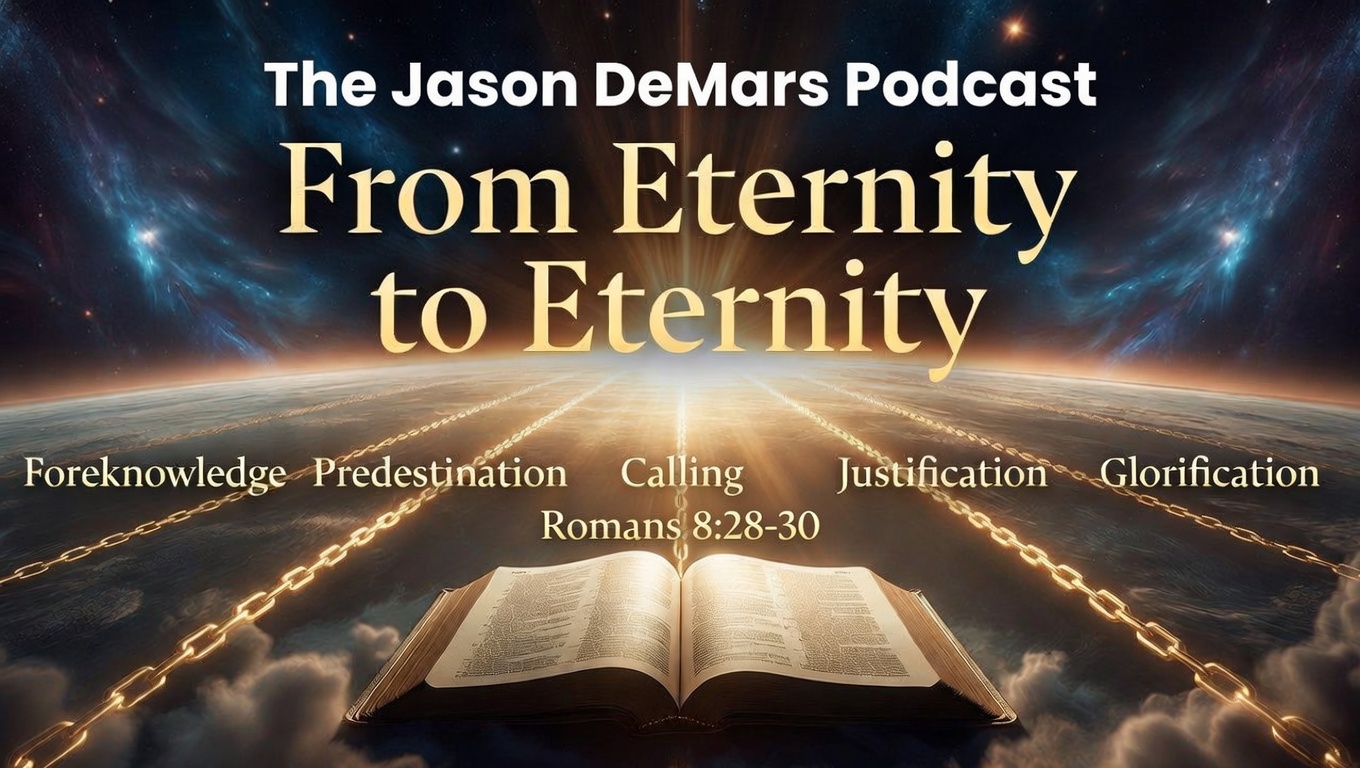
Romans 8:28-30 is often quoted as comfort, but the episode presses us to read it as a precise statement about God’s purpose, not a vague optimism. “All things work together for good” is framed by the realities of tribulation, persecution, distress, and loss, so the “good” cannot mean that pain is pleasant or that hardship is automatically virtuous. The good is defined by verse 29: God is conforming believers to the image of His Son. That focus changes the way Christians interpret suffering, guidance, and delay. Instead of asking only “Why did this happen?”, the passage invites the deeper question: “How is God using this to shape me into Christlikeness within His eternal plan?”
From there, the conversation follows what is often called the golden chain of salvation: foreknowledge, predestination, calling, justification, and glorification. Foreknowledge is presented not as God merely predicting human decisions, but as God’s counsel and purpose declared “from the beginning,” rooted in planning, speaking, doing, and bringing to pass. Scriptures like Isaiah 46 and Acts 2 are used to argue that God’s foreknowledge is inseparable from His determinate counsel. The episode also ties foreknowledge to election language in 1 Peter 1, stressing that salvation is not God reacting to history but God unfolding a pre-planned redemption. For listeners searching “Romans 8 foreknowledge meaning” or “does God plan everything,” this section lands on a strong view of sovereign grace.
Predestination is then treated as God fixing a destiny beforehand, with Romans 8:29 and Ephesians 1 as key texts. The point is not simply that God chooses an outcome, but that believers are chosen “in Christ” before the foundation of the world, in love, and brought into an inheritance according to God’s will. The episode emphasizes that redemption includes revelation: God makes known the mystery of His will and teaches His people wisdom and prudence as part of His saving work. This frames Christian identity as more than a moment of decision; it is participation in an eternal purpose. For those exploring “predestination in the Bible,” “Ephesians 1 explained,” or “Christian election doctrine,” the argument is that God’s purpose stands and cannot be thwarted by human will.
Calling becomes the practical bridge between eternity and time. The episode distinguishes the general gospel invitation, where “many are called,” from the effectual calling of the elect described in Romans 8:30. Using New Testament passages about being “called to be saints” and “called into fellowship,” calling is portrayed as God’s summons that ultimately succeeds because Christ loses none the Father gives Him. The discussion then moves to justification by faith: God remains just while justifying sinners because judgment is laid on Christ, so the believer stands as though they never sinned. Finally, glorification is held out as the promised completion: the redemption of the body, a future transformation patterned after Christ’s glorious body, with the Holy Spirit as the earnest and guarantee. The chain ends where it began, with assurance: God finishes what He starts, from eternity past to eternity future.

Leave a Reply